Native-Art-in-Canada has affiliate relationships with some businesses and may receive a commission if readers choose to make a purchase.
- Home
- Indian Group of Seven
- Indian Group of Seven Influence
Indian Group of Seven Influence
Over the years the Indian Group of Seven influence on the development of
native art in Canada has been stunning. It started slowly, first
impacting the lives of a handful of Morrisseau's young relatives in Red Lake, Ontario. Then on Manitoulin Island,
birthplace of Daphne Odjig.
The Kakegamic brothers - Goyce, Josh and Henry - began painting as teenagers under the guidance of their Ojibwa brother-in-law, Norval Morrisseau.
After learning printmaking techniques at Open Studio in Toronto, the brothers opened Triple K Cooperative in the gold mining town of Red Lake, Ontario. In turn, the Co-op had a major influence on the careers of many emerging woodland artists.
Inspired by the reception that Morrisseau was receiving in mainstream Canada, Tom Peletier (in 1966) created the Manitou Arts Foundation in an attempt to encourage young people to venture into the world of art.
In 1973 the Foundation hosted a summer school for Ojibwa youth on Schreiber Island in the north channel of Lake Huron. Daphne Odjig, Carl Ray and Gerald Dokis were the resource people.
Among the students were:
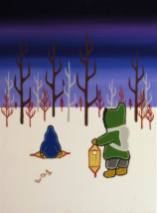
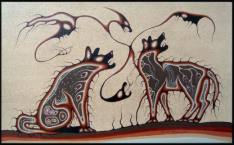
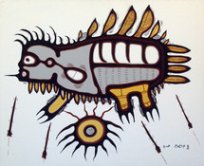
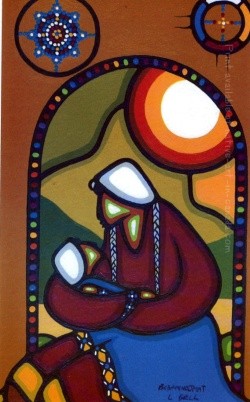
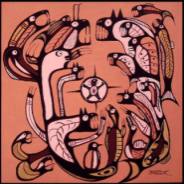
Cultural history, legends and traditional stories were what most inspired the young painters but they were also interested in interpreting the natural world around them.
Except for Martin Panamick who died shortly after, the others have gone on to achieve reputations as artists with their own unique visions and styles that still bear certain indications of their origin in Manitoulin's Manitou Arts program. .
Indian Group of Seven Influence -
The Ojibwe Cultural Foundation
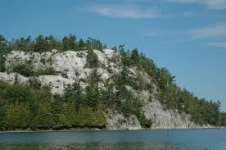
These young artists later found mutual support and a cultural framework through the summer art programs organized by another organization called the Ojibwe Cultural Foundation, which continued the arts and culture programs of the shorter-lived Manitou Arts Foundation.
In 1976 and 1977, the summer arts site chosen was Dreamer's Rock on the Birch Island Reserve of Manitoulin. The site had spiritual significance because in the past, young Anishinaabeg (that's what the Ojibwa people call ourselves) had gone there on a vision quest to seek direction in their lives.
Organizers of the summer school hoped that the choice of the site might inspire the young people to develop their own individual artistic visions. The meetings indeed strengthened Indian ways and values - as seen in their paintings and drawings that celebrated old ceremonies and new dreams.
Unfortunately the area around Dreamer's Rock was heavily vandalized and trashed in 1974 by non-native residents of Manitoulin...perhaps in response to Native activism, both in the U.S. and Canada, concerning Native land, rights and sovereignty. At the time there was a good deal of hatred and backlash from many white people about this.
The young people, sad and angry about the vandalism, cleaned it up and then traditional elders re-consecrated the site. They smudged with sacred cedar and held sweat lodge purification ceremonies - the first time many of the young artists had been exposed to that part of their heritage.
The Indian Group of Seven influence has continued through three generations of woodland artists.

Although the training, lifestyles and creative motivation of contemporary native artists differ profoundly from their ancient counterparts, today's Woodland Art is sourced by traditional artistic representations used by prehistoric Eastern Woodland Indians.
The Woodlands School Rennaissance
In ancient times art was used to bridge, reconcile, re-educate and re-orient fellow native groups, however hostile. Today the challenge is to bridge the gap between entirely different cultures - First Nations people and Euro-Americas.
Other Native Artists
As the younger generations try their hand at painting, many take the Morrisseau imagery for granted...not realizing that it didn't exist in the modern world until he brought it forth.
 |
 |
 |