Native-Art-in-Canada has affiliate relationships with some businesses and may receive a commission if readers choose to make a purchase.
- Home
- Woodland Imagery
Woodland Art
Three Major Schools of Native Art in Canada
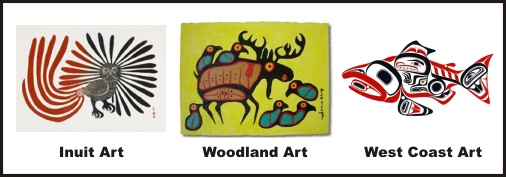
Woodland art, west coast art and Inuit art are three recognized schools of art popularized by many contemporary Canadian native artists. All three categories have been sourced from ancient traditions that, despite the persistent and pervasive forces of acculturation, have endured to the present day.
The woodland style developed as a direct result of the imagery Norval Morrisseau brought forth into the world in the early 1960's when, despite censure from elders in his comunity, he chose to make public the spiritual concepts inherent in the midiwewin spiritual concepts.
Although the training, lifestyles and creative motivation of contemporary native artists differ profoundly from their ancient counterparts, today's Woodland art is actually sourced by traditional artistic representations used by prehistoric ancestors.
Three Categories of Imagery in Woodland Art
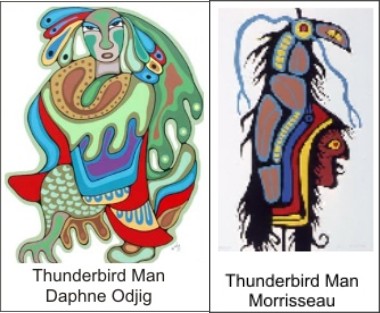
A second similarity common to contemporary and prehistoric traditions is the prevalence of images of transformation otherwise known as simultaneity.
That means, representations of a man or an animal being two life forms at the same time. For example, both Norval Morrisseau and Daphne Odjig did paintings they entitled Thunderbird Man.
Their human/bird imagery is powerfully suggestive of similar human/bird images carved into both copper and shell from pre-historic sites that date from 1000AD and 1400AD.
Humans Frequently Struggle With Animals
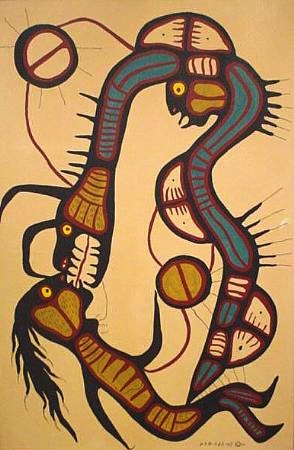
A third common theme in pre-historic and contemporary native art from the Eastern Woodlands is the portrayal of spiritual communication or even fighting between animals and human beings...as in this painting by Norval Morrisseau depicting a man in communication with a serpent.
I'm trying to locate images of two paintings by Daphne Odjig and Carl Ray ... both entitled Conflict between Good and Evil...that show the common interpretation of the subject.
If you own either piece and would be willing to share a photo, please contact me through the link at the bottom of this page.
A Form and It's Background Merge Together
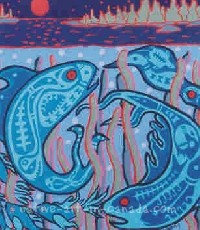
Imagery incised on prehistoric eastern woodland's pottery and shell gorgets often confused the observer when he tried to distinguish the relationship between a form and its background. This tendency to be imprecise in the definition of positive and negative space was so basic to the ancient traditions that it reflects the essence of the structures and classification systems of the culture.
Despite the forces of acculturation, similar ambiguities persist in modern interpretations.
The painting on the left I entitled "What's for Lunch?" which illustrates the interconnection between all life forms. A fish is eating a fish that's eating a loon that has eaten a fish, etc. If you look closely you might be able to count eight loons and five fish inside the fish on the left. Maybe I should have called it "A Fish Story".
But there are other, perhaps even more important connections between the prehistoric and the present day artistic traditions.
To understand the significance of today's imagery, compare the explosive emergence of Woodland Art within the mainstream of Canadian culture to the bursts of artistic and ritual activity developed in response to cultural crisis in pre-contact times.
Woodland Art has always had a profound impact on woodland culture.

Some discussion on the meaning of the symbols used in by woodland artists.
The Impact of Contemporary Woodland Artists
The handful of artists that followed in Morrisseau's footsteps eventually made a profound impact.
By the mid-twentieth century in Canada Ojibwa society was in disarray. The Reserve system, the Christian churches and the residential school system had been working for years to eliminate traditional beliefs and social customs. Morrisseau fought back by using imagery that represented the traditional knowledge of the Ojibwa to restart the inquiry into what it means to be Anishnabe.
 |
 |
 |